
Atascosa Court Records After Arrest
The court path after an Atascosa County jail arrest is separate from the jail record. The jail record starts at intake, when the Atascosa County Sheriff's Office or another arresting agency books the person into custody. The court record starts when a prosecutor files a complaint, information, or indictment in the proper court. Those filed papers create the case record that later shows settings, charge status, bond orders, plea settings, dismissal entries, trial dates, and final disposition.
That split matters. Booking charges can be broad, early, or tied to the arresting officer's report. Prosecutor-filed charges can be different after the 81st Judicial District Attorney or local prosecutor reviews reports, evidence, and witness information. For custody and booking details, use Atascosa County jail inmate records. For booking photographs and records-request routes, use Atascosa County jail mugshots. Court records after a jail arrest are the case side of the same event.
Atascosa Court and Clerk Routing
The official Atascosa County District Clerk page is the main local court-record routing point. It names Margaret E. Littleton as District Clerk, lists the office at 1 Courthouse Circle Drive Suite 4-B in Jourdanton, and links the county's online records search through LGS. The District Clerk page also notes mandatory e-filing for civil and criminal cases and links the district court site for the 81st and 218th Judicial District Courts.
Felony-level Atascosa County court records after a jail arrest usually move through the 81st Judicial District Attorney and the 81st/218th District Court system. The county page names Audrey Louis as the 81st Judicial District Attorney and lists Atascosa prosecutor staff. Misdemeanor and county-court criminal matters can route through the Atascosa County Court at Law, which publishes criminal docket PDFs through its court site.
Core Court Contacts
District Clerk: 1 Courthouse Circle Drive Suite 4-B, Jourdanton, TX 78026; 830-769-3011.
81st Judicial District Attorney: 1105 A St., Floresville, TX 78114; 830-393-2200.
County Court at Law: 1405 Campbell Ave Suite 104, Jourdanton, TX 78026; 830-769-4232.
Atascosa LGS Court Records Search
The District Clerk links to LGS Online Records Search. The direct login screen at LGS Online Records Search login shows account login fields and a Guest Login button. The research did not capture a full post-login field list, so the reliable claim is narrower: LGS is the county-linked court-record portal, and users may need to use Guest Login or create an account to reach available case indexes.
| LGS Control | How It Applies to Court Records |
|---|---|
| Email Address | Used for registered account login. The page script converts the entry to lowercase. |
| Password | Used with a registered account, if the user has one. |
| Login | Submits account credentials for the official county-linked portal. |
| Guest Login | Displayed as a guest path for users who do not have account credentials. |
| Forgot Password, New Account, Questions | Support links for account recovery, registration, and portal help. |
The District Clerk source page is the source link for LGS in Atascosa County. The advertised online-records guide PDF returned a 404 during research, so LGS should be used directly rather than relying on that PDF.
The official District Clerk page shows the local records routing point for Atascosa court cases after arrest.
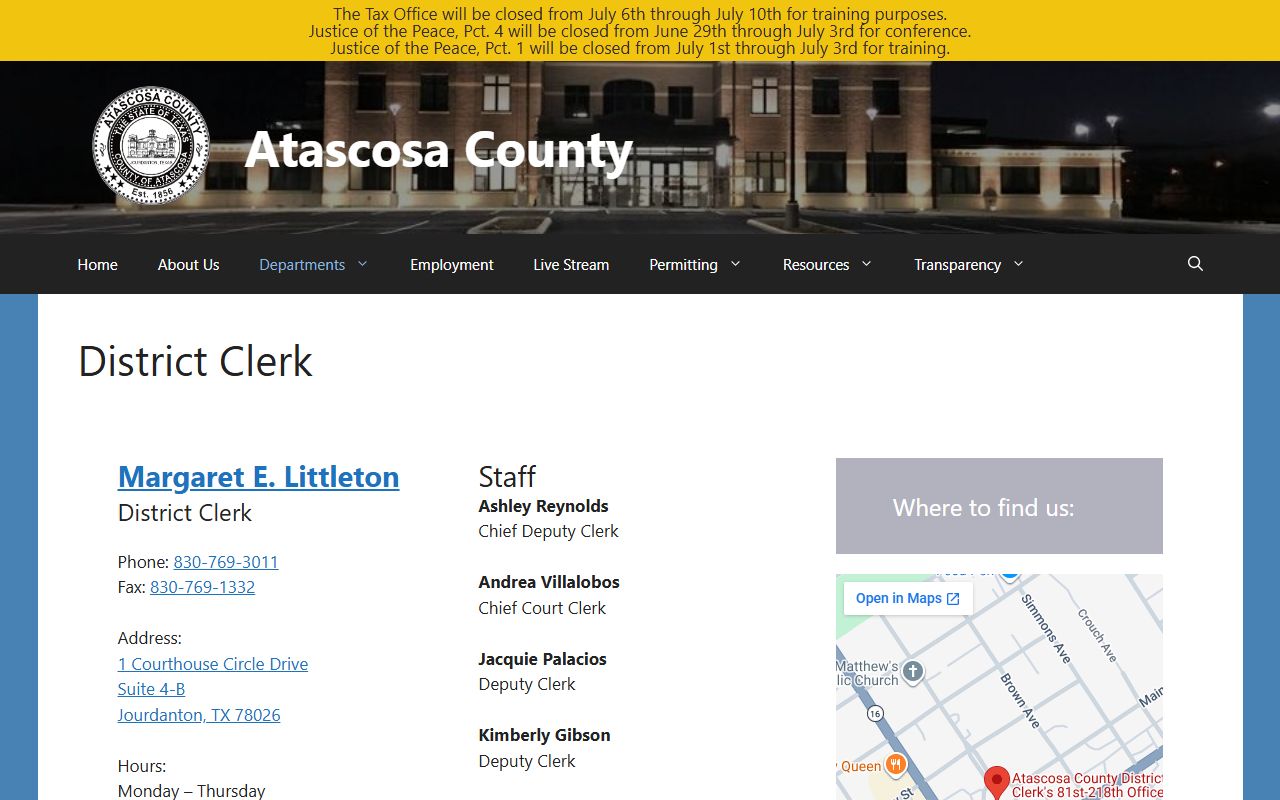
The screenshot matches the court-record workflow because it shows where Atascosa County routes users before they reach LGS, district court links, and expunction service information.
Atascosa Criminal Docket Records
Dockets are often the fastest free way to see whether a charge has reached court after a jail arrest. The 81st/218th District Court dockets page publishes weekly docket links for the multi-county district that includes Atascosa, Frio, Karnes, La Salle, and Wilson Counties. Atascosa criminal docket PDFs are identified by county and criminal docket labels. The Atascosa County Court at Law dockets page publishes dated criminal docket PDFs for county-court matters.
Docket PDFs do not replace the full case file. They are public schedules. A docket entry may show a cause number, defendant or style, setting type, hearing date, time, court, attorney information, and notes. A docket can show that a case is set, continued, or heard, but it may not show every filed document. For full case history, use LGS or contact the right clerk.
- Confirm the person was booked or charged in Atascosa County, not only held on another county's warrant.
- Search LGS through the District Clerk link for filed cases by name or case number when available.
- Check district court dockets for felony settings and felony-level court dates.
- Check County Court at Law dockets for misdemeanor and county-court criminal settings.
- Use the clerk when a case is sealed, old, not indexed, newly filed, or not visible online.
The 81st/218th District Court docket page is the official source for weekly district docket PDFs.
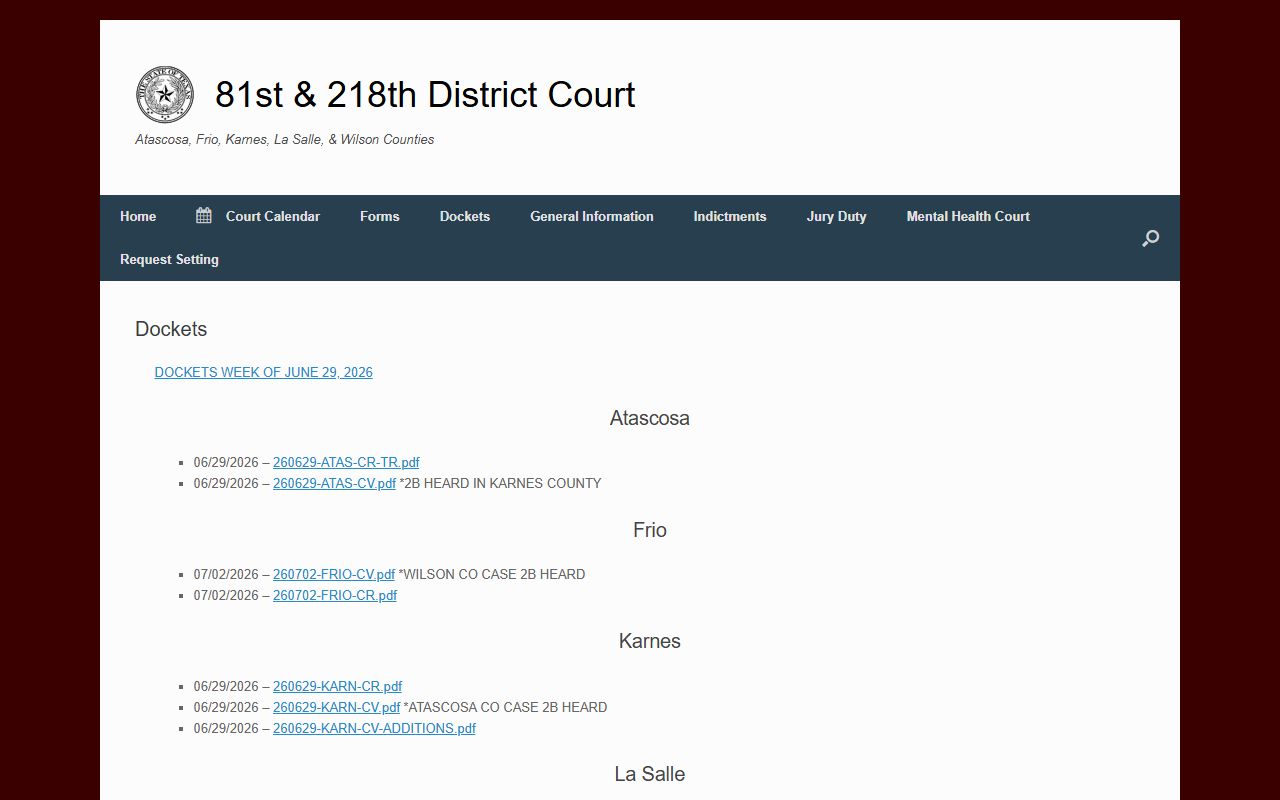
The docket page is useful after an arrest because it shows the court schedule once a filed case reaches district court.
Atascosa Arrest Charging Documents
After an Atascosa County arrest, the charging paper controls how the case appears in court records. A complaint may begin a case or support early proceedings. An information is a prosecutor-filed charging document. An indictment is a grand-jury charging document, most often tied to felony prosecution. The 81st/218th District Court site also has an indictments page, which is relevant when an arrest leads to felony grand-jury action.
| Document | Who Creates It | Common Use | What to Check |
|---|---|---|---|
| Complaint | Officer or prosecutor | Early criminal accusation and some misdemeanor matters | Name, alleged offense, date, court, and probable-cause basis. |
| Information | Prosecutor | Many misdemeanor and non-indictment prosecutions | Filed charge, degree or level, cause number, and prosecutor signature. |
| Indictment | Grand jury | Felony cases after grand-jury review | Count numbers, offense text, date range, and district court assignment. |
Do not assume the first jail booking charge is the final filed charge. The District Attorney may file a different charge, add a count, reduce the charge, dismiss a count, or present the case to a grand jury. The court record is the better source for the filed case status.
Atascosa Charge Status Records
Charge status tells the reader where a count stands. It does not always tell the full story of guilt, release, or sentence. A pending charge is still open. An amended or reduced charge has changed from an earlier version. A dismissed charge ended without conviction on that count. An indicted felony means the grand jury returned a felony charging instrument. A disposition is the final case outcome.
| Status | Plain Meaning | Atascosa Search Tip |
|---|---|---|
| Pending | The charge or case has not reached final disposition. | Check LGS and the latest docket date. |
| Amended or reduced | The filed charge changed by prosecutor action or court order. | Compare the booking charge with the later court entry. |
| Dismissed | The count or case ended without conviction on that count. | Ask the clerk whether the dismissal order is available. |
| Indicted | A grand jury returned a felony charging instrument. | Use district court records and indictment postings where available. |
| Disposition | The final outcome, such as plea, verdict, dismissal, or other order. | Use the full case file, not only a docket listing. |
Atascosa Bond After Arrest
Bond is part of the arrest-to-court path, but it is not proof of guilt. Texas Code of Criminal Procedure article 15.17 controls the magistrate-warning stage after arrest, and Code of Criminal Procedure chapter 17 governs bail, bond, and release conditions. In Atascosa County, bond status should be confirmed through Booking/Inmate Information or Jail Records, then compared with the court case if an order has been entered.
| Bond Type | How It Works | Local Note |
|---|---|---|
| Cash bond | Money is posted to secure release and appearance. | Confirm amount and accepted payment before arriving. |
| Surety bond | A bail bond company or surety posts bond. | The Sheriff posts a state bond fee of $15 per surety bond, maximum $30. |
| Personal or PR bond | Release is based on promise to appear and court conditions. | Requires magistrate or court authorization. |
| No-bond hold | Release is not available until a judge or holding agency acts. | Can involve serious charges, parole, warrants, federal, or immigration holds. |
The Sheriff page lists daily inmate release times as 8:00 a.m. and 10:00 p.m. That does not mean every person leaves at those times. Other holds, paperwork, warrants, or transfer orders can delay release after bond is posted.
Atascosa Warrants and Arrest Records
No official Atascosa County online active-warrant search was located on the Sheriff page. After a warrant arrest, the warrant can appear in the jail booking path, the bond status, and later court records. Before arrest, the issuing court, municipal court, JP court, or law-enforcement agency may be the better source. The Sheriff page gives Civil Process Status, Booking/Inmate Information, Criminal Investigation, Reports, and Open Records routing, but that is not the same as a public warrant search database.
- Bench warrant or capias
- A court order often tied to failure to appear or failure to comply with court terms.
- Detainer
- A hold or request from another agency, such as parole, federal custody, immigration, or another county.
- Warrant bond
- A bond amount or condition set by the warrant or issuing court.
Atascosa Charges vs Convictions
An Atascosa County arrest and a filed charge are not the same as a conviction. A charge is an accusation that starts or shapes a criminal case. A conviction follows a guilty plea, verdict, or qualifying final judgment. The distinction is vital for court records after a jail arrest because many searches show pending accusations, docket settings, and dismissed counts alongside final outcomes.
| Issue | Charge | Conviction |
|---|---|---|
| Stage | Accusation after arrest or prosecutor filing. | Final finding or plea resulting in guilt. |
| Proof level | Based on probable cause or filed accusation. | Requires proof beyond a reasonable doubt or a valid plea. |
| Record meaning | May remain pending, be amended, or be dismissed. | May affect sentence, custody, supervision, and criminal-history records. |
| Where to verify | LGS, dockets, clerk, charging document. | Final judgment, disposition, DPS conviction records where applicable. |
Atascosa Sealed vs Expunged Records
Texas law gives some people a path to clear or restrict arrest and charge records, but eligibility depends on the case result and the statute. Texas Code of Criminal Procedure chapter 55 governs expunction of qualifying arrest and criminal records. The Atascosa District Clerk page is also useful because it lists service-party routing for expunction matters, including the Sheriff, County Attorney, District Attorney, DPS, FBI/NCIC, municipal courts, JP courts, and local police departments.
| Record Action | Plain Meaning | Practical Limit |
|---|---|---|
| Sealed or restricted | Public access is limited, but some official access may remain. | Not the same as destroying the record. |
| Expunged | A qualifying record is removed or treated as if it did not occur under the order. | Requires eligibility and proper service on agencies. |
| Dismissed without expunction | The charge ended, but records may still exist. | A dismissal alone is not always a deletion order. |
Statewide background records follow a different path. Texas DPS Crime Records Service and the public conviction name-search service can show criminal-history data, but those systems are not the Atascosa jail roster and are not a substitute for the local case file.
Restricted Atascosa Court Records
Some Atascosa County court records after an arrest may not be available in a public portal. Juvenile matters, sealed records, expunged records, sensitive law-enforcement material, and some active-investigation records can be limited by law or court order. The Texas Public Information Act, Government Code chapter 552, controls public access to many government records, but court records, clerk files, and law-enforcement records do not all follow the same release path.
Important: Public case lookup is not an FCRA consumer report and should not be used for employment, tenant, credit, or insurance screening.